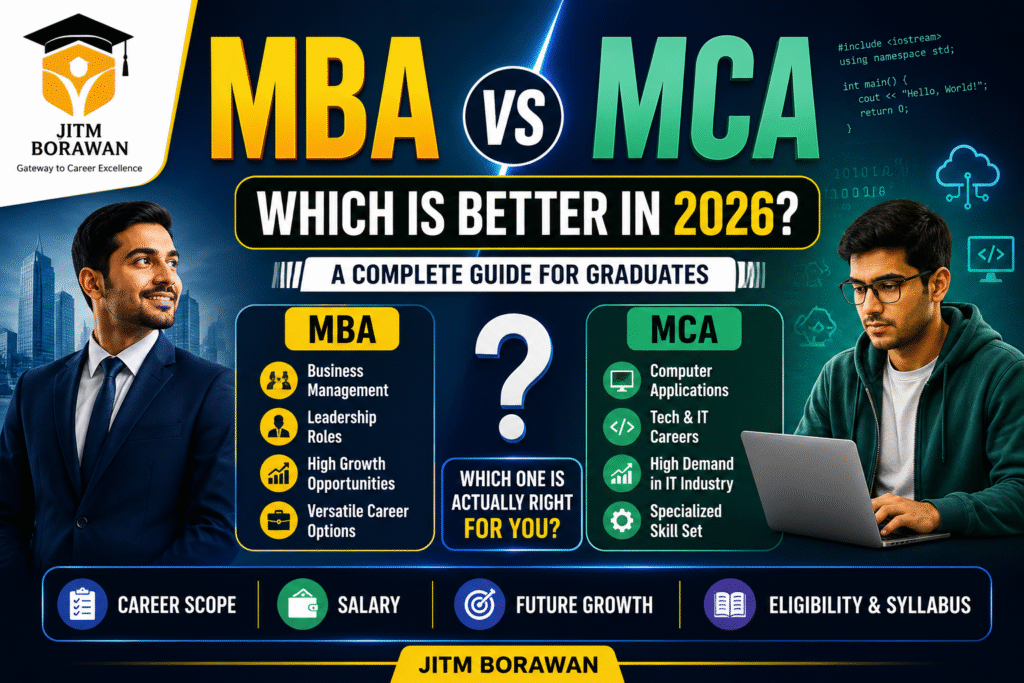
Every year, thousands of graduate students across India sit with the same question stuck in their heads: should I do MBA or MCA?
And honestly, it is not a simple question to answer. Both are two-year postgraduate courses. Both can lead to great jobs. Both are in demand. But they take you in completely different directions and that is exactly why choosing between them feels so overwhelming.
If you pick the wrong one, you spend two years studying something that does not match your personality, your strengths, or your actual career vision. That is a costly mistake, not just in money but in time and energy.
This guide is written to give you an honest, detailed, and clear comparison of MBA vs MCA in 2026 covering eligibility, syllabus, career scope, salary, and the one question that matters most: which one is actually right for you?
Let us start from the very beginning.
What is an MBA and What is an MCA? Understanding the Basics First
Before we compare anything, let us make sure we are on the same page about what these two courses actually are, not just the full form, but the real meaning.
MBA – Master of Business Administration
MBA is a management degree. It is designed to teach you how businesses run, how decisions are made, how teams are led, how markets work, how money flows, and how organisations grow. An MBA graduate is someone who understands both the big picture and the day-to-day operations of a business.
The degree covers subjects like marketing, finance, human resources, operations, strategy, entrepreneurship, and business communication. It is not about becoming a technical expert in one area, it is about becoming someone who can manage, lead, and build.
MBA is also one of the most flexible postgraduate degrees in the world. It does not matter if you studied science, commerce, or arts in your undergraduate years. MBA welcomes students from every background, which makes it accessible to almost anyone.
MCA – Master of Computer Applications
MCA is a technical degree. It goes deep into the world of computers, software, and technology. You learn programming languages, how to build software systems, how databases work, how networks are designed, and increasingly how artificial intelligence and machine learning function.
An MCA graduate is someone who can write code, build systems, and solve technical problems. It is a specialist degree, not a generalist one. The path after MCA is clearly focused on the tech industry software development, data analysis, cybersecurity, AI engineering, and similar roles.
MCA does have eligibility restrictions; you typically need a background in computer applications or mathematics to pursue it. So not everyone can simply opt for MCA the way they can opt for MBA.
Eligibility Criteria – Who Can Apply for What?
This is often the first filter that naturally helps students narrow down their options.
MBA Eligibility (General + JITM Borawan)
MBA is open to graduates from any stream — B.A., B.Com., B.Sc., BBA, B.Tech., or any other three-year or four-year undergraduate degree.
At JITM (Jawaharlal Institute of Technology & Management), Borawan, the eligibility for the MBA programme is:
- A minimum three-year Bachelor’s degree with at least 50% aggregate marks
- Candidates from reserved categories need a minimum of 45% marks
- Students appearing in their final year of graduation can also apply provisionally
- Preference is given to candidates with valid scores in CMAT, CAT, MAT, or state-level entrance exams
- Special fee relaxation is available for children of serving or retired defence personnel
MCA Eligibility (General)
MCA typically requires:
- A Bachelor’s degree in BCA, B.Sc. (Computer Science / IT), or any graduation where Mathematics was a compulsory subject
- Some universities also accept B.Com. or B.A. with Mathematics
- If you graduated in a stream with no Mathematics or computer science background, MCA may not be accessible without bridging
The simple takeaway: If you are from any stream and want a postgraduate degree without stream restrictions, MBA is the easier path. MCA has a more defined eligibility requirement that may limit your options depending on your undergraduate background.
Also Read : BBA के बाद Best Career Options 2026 | MBA, Job या Startup?
Course Syllabus – What Will You Actually Study?
This is the section most students skip when choosing a course. They read about career outcomes but not about the actual journey. Knowing the syllabus helps you understand whether you will enjoy the next two years and that matters a lot.
MBA Syllabus — What JITM Teaches
JITM’s MBA curriculum is structured practically and progressively. Here is a broad view of what students cover:
Year One — Building the Foundation
| Semester | Key Subjects |
| Semester 1 | Principles & Practice of Management, Quantitative Techniques, Accounting for Managers, IT & E-Business Fundamentals, Business Environment, Organizational Behavior, Business Communication, Managerial Economics |
| Semester 2 | Operations Research, Operations Management, Entrepreneurship, Financial Management, Marketing Management, Human Resource Management, Business Ethics & Indian Ethos, Business Research Methods |
Year Two — Choosing Your Specialization
In the second year, students pick their area of focus. JITM offers specializations in:
- Marketing Management
- Financial Management
- Human Resource Management
- IT Management
Both semesters in Year Two include compulsory subjects like Supply Chain Management, Project Management, Business Legislation, and Strategic Management along with elective subjects specific to your chosen specialization. The programme concludes with a Management Research Project (MRP) / Internship and a Comprehensive Viva-Voce.
Beyond classroom learning, JITM provides three industrial visits per year giving students real exposure to how companies actually operate. Regular expert lectures and industry talks are also organized throughout the programme.
MCA Syllabus — What You Study in General
MCA programmes across universities typically cover:
- Programming languages: C, C++, Java, Python
- Data Structures and Algorithms
- Database Management Systems (DBMS)
- Operating Systems and Computer Networks
- Web Technologies and Application Development
- Software Engineering principles
- Artificial Intelligence and Machine Learning (in modern curricula)
- Cybersecurity fundamentals
The core difference in a single line: MBA teaches you how to run a business. MCA teaches you how to build the technology that businesses run on.
Career Scope in 2026 – Where Does Each Degree Take You?
This is where students pay the most attention, and rightly so. Let us look at career options honestly without sugarcoating anything.
Career Paths After MBA
MBA opens doors across virtually every industry. Some of the most common career roles for MBA graduates include:
- Marketing Manager — creating and managing brand strategy, digital campaigns, and customer acquisition
- Business Analyst — identifying business problems and designing data-driven solutions
- Financial Analyst — managing investments, budgets, and financial reporting
- HR Manager — handling recruitment, performance management, and organisational culture
- Operations Manager — overseeing supply chains, logistics, and day-to-day business processes
- Brand Manager — building and maintaining the public image of a product or company
- Entrepreneur / Business Owner — starting and scaling your own venture
What makes an MBA particularly powerful in 2026 is its versatility. A marketing MBA grad can work in FMCG, tech, healthcare, or e-commerce. A finance MBA grad can work in banking, investment, insurance, or consulting. The degree travels across sectors, which gives you flexibility even if your first industry does not work out.
At JITM, MBA graduates have already secured placements with reputed companies. The college’s strong recruiter network and placement-focused approach gives students a genuine headstart in the job market.
Also Read : BBA vs B.Com | Which Course is Right for You in 2026 ?
Career Paths After MCA
MCA graduates typically enter the tech world in roles such as:
- Software Developer or Software Engineer
- Web Developer (Front-end, Back-end, or Full-stack)
- Data Analyst or Database Administrator
- System Analyst or IT Consultant
- Network Engineer
- AI or Machine Learning Engineer (with additional specialization)
- Cybersecurity Analyst
The tech industry continues to grow, and MCA graduates have strong opportunities especially in 2026, where AI, cloud computing, and data engineering are among the fastest-growing areas.
One honest reality check: MCA and B.Tech Computer Science graduates often compete for the same jobs. In many top-tier tech companies, B.Tech CS is preferred over MCA not because MCA is weaker, but because the recruiting pipeline is designed that way. This does not mean MCA graduates cannot succeed, many do brilliantly but it is important to know the landscape before you commit.
Salary Comparison 2026 – Let the Numbers Speak
Everyone wants to know about money. Here is a realistic salary comparison based on current market trends:
| Profile | Starting Salary (Approx.) | Salary After 5 Years |
| MBA – Marketing / Finance | ₹4 – 7 LPA | ₹10 – 20 LPA |
| MBA – Top B-School Graduate | ₹8 – 15 LPA | ₹20 – 40 LPA |
| MCA – Software Developer / Analyst | ₹4 – 8 LPA | ₹10 – 25 LPA |
| MCA – AI / ML Specialization | ₹6 – 12 LPA | ₹18 – 35 LPA |
Both degrees offer competitive starting salaries. The real difference shows up over time:
- MCA graduates in tech roles can earn very well early especially if they specialise in high-demand areas like AI or cloud.
- MBA graduates in management roles tend to see steeper salary growth as they move into senior leadership, where compensation packages combine salary, bonuses, and sometimes equity.
The bottom line: Neither is clearly “higher paying.” It depends heavily on your specialization, your skills, the company you join, and how aggressively you grow your career.
MBA vs MCA – A Direct Feature Comparison
Here is a quick side-by-side view of both courses across the most important parameters:
| Parameter | MBA | MCA |
| Course Type | Management | Technical |
| Duration | 2 Years | 2-3 Years |
| Eligibility | Any Graduate (50% marks) | BCA / B.Sc. CS / Maths background |
| Core Focus | Business, Leadership, Strategy | Programming, Software, Technology |
| Specializations | Marketing, Finance, HR, IT Mgmt | Software Dev, AI/ML, Data Science |
| Job Roles | Manager, Analyst, Entrepreneur | Developer, Engineer, Data Analyst |
| Industry Reach | All Industries | Primarily Tech & IT |
| Growth Ceiling | High (Leadership / CXO Track) | High (Tech Leadership / Architect) |
| Entrepreneurship Fit | Very High | Moderate |
Which One Should You Choose? Be Honest With Yourself
This is the most important section and it requires you to stop thinking about what sounds impressive and start thinking about who you actually are.
Choose MBA if you identify with any of these:
- You genuinely enjoy talking to people, understanding their needs, and persuading them
- You like the idea of managing a team or running a department
- Your undergraduate background is in commerce, arts, or a non-technical field
- You have always thought about starting your own business someday
- Numbers and strategy excite you financial planning, market analysis, business models
- You want a degree that works across industries, not just one sector
- You are unsure about your direction but want a versatile, respected postgraduate qualification
Choose MCA if you identify with any of these:
- You genuinely enjoy coding and find it satisfying when a programme works correctly
- You want to build software, apps, or systems as your primary career
- Your undergraduate background is in BCA, B.Sc. CS/IT, or you have a mathematics background
- You want to specialize in AI, machine learning, data science, or cybersecurity
- You prefer working with systems and logic over people and strategy
- You are comfortable with continuous technical upskilling as technology evolves
One clear rule of thumb: If you are genuinely confused between the two and feel no strong pull toward either, MBA is usually the safer and more versatile choice. It does not lock you into a single career path and works across every industry. MCA is a more specific commitment and you should pursue it only if technology genuinely excites you.
Also Read : Best MBA College Near Khandwa 2026 | Fees, Admission and Placement Guide
The 2026 Factor – How the Job Market Has Changed
It would be incomplete to compare MBA and MCA without addressing what 2026 looks like in the real world.
The biggest shift happening right now is the convergence of business and technology. Companies no longer want people who are only good at one thing. They want professionals who understand both the technical side and the business side.
This is creating a huge demand for:
- MBA graduates with basic tech literacy — people who understand data analytics, digital marketing tools, and AI-powered decision making
- Tech professionals who can think strategically — people who can translate technical output into business value
JITM’s MBA curriculum already acknowledges this shift. Subjects like IT & E-Business Fundamentals and specialization in IT Management are included precisely so that MBA graduates are not just business thinkers they are tech-aware business leaders.
For MCA graduates, the opportunity lies in high-growth tech domains like AI engineering, cloud architecture, and cybersecurity but these require ongoing upskilling beyond just the MCA degree itself.
The professionals who will thrive in 2026 and beyond are those who combine domain knowledge with cross-functional thinking. MBA naturally builds this mindset. MCA builds deep technical expertise. Both are valuable in different ways and for different kinds of people.
Why JITM Borawan is Worth Considering for Your MBA
If you have read this far and you are leaning toward MBA, here is why JITM (Jawaharlal Institute of Technology & Management), Borawan deserves serious consideration especially if you are from Madhya Pradesh or central India.
JITM was established under the Jawaharlal Nehru Charitable Educational Trust in 1996 and has since built a reputation for providing quality, practical management education in the Nimar region.
Here is what makes JITM stand out:
- 45-Acre Green Campus in Borawan, Khargone a distraction-free environment built for focused learning, with modern classrooms, a well-stocked library, computer labs, hostels, and sports facilities all on campus
- Structured MBA Curriculum that covers all four years of subjects progressively from core management principles in Semester 1 to specialization and strategic management in Semester 4
- Three Industrial Visits Per Year — students get to visit real companies and see how operations, management, and decision-making work in practice, not just in textbooks
- Regular Expert Lectures and Industry Talks — professionals from various industries regularly interact with students, bringing real-world context into the classroom
- Four Specialization Tracks — Marketing, Finance, Human Resource Management, and IT Management — so students can align their degree with their career goals
- Scholarship Opportunities — JITM has announced 100% MBA scholarships for a limited number of deserving students, along with special fee relaxation for children of serving or retired defence personnel
- Active Placement Support — JITM’s placement network includes reputed recruiters who visit campus, giving students genuine job opportunities upon completion
- Inclusive Admissions — any graduate with 50% marks from any stream can apply, and final-year students can apply provisionally without waiting to receive their results
Here is what one of JITM’s own MBA students had to say:
“Joining the MBA program at JITM Borawan gave me a strong foundation in business and management. The interactive teaching methods and case-study based learning helped me develop critical thinking and decision-making skills. The faculty always encourages us to participate in competitions and real-world projects, which makes learning exciting.” — Radha Bhattad, MBA Student, JITM
Final Verdict — MBA vs MCA in 2026?
There is no universal answer here, and anyone who tells you one is clearly better than the other without knowing your background and goals is not giving you real advice.
Here is the clearest way to think about it:
- If technology excites you, you enjoy coding, and your academic background supports it → MCA is the right path.
- If you want to lead, manage, build businesses, or work across industries → MBA is the right path.
- If you are unsure → MBA is the safer, more versatile bet in 2026.
MBA will not close the door on technology especially if you choose an IT Management specialization or join a tech company in a business role. But MCA will close the door on non-tech career paths.
That asymmetry is worth thinking about seriously.
And if you have decided that MBA is your direction and you are in Madhya Pradesh or central India JITM Borawan offers a structured, industry-connected, and scholarship-supported programme that is worth your genuine consideration.
Frequently Asked Questions (FAQ)
Q1: Can I do an MBA right after graduation without work experience?
Yes, absolutely. Most MBA programmes including JITM’s are designed for fresh graduates. Work experience is an advantage but not a requirement. What matters more is your attitude, communication skills, and willingness to learn.
Q2: Is MCA + MBA a good combination?
It can be a very powerful combination, especially if you want to move into tech leadership roles like Product Manager, IT Director, or CTO. MCA gives you the technical foundation, and MBA gives you the management perspective. However, it is also a longer journey than 4+ years of postgraduate study.
Q3: Which has better scope in India — MBA or MCA?
Both have strong scope in India in 2026. MBA has wider scope across all industries. MCA has a concentrated but high-demand scope in the tech sector. Your personal interest and background should guide the decision, not just market trends.
Q4: Can I get a government job after MBA?
Yes. MBA graduates can appear for management trainee positions in PSUs (Public Sector Undertakings), bank management exams, and various government enterprise roles. It is a viable and often overlooked option.
Q5: Is distance MBA as good as regular MBA?
For subject knowledge, distance MBA can be useful. But for networking, placements, industrial visits, and the overall college experience regular MBA wins significantly. If you want campus placements and real industry exposure, a regular programme like JITM’s is the right choice.
Q6: How can I apply to the JITM Borawan MBA programme?
You can visit jitm.co.in and fill out the registration form directly online. You can also reach the admissions team at 07999231575 or write to jitm.borawan@gmail.com. The campus is located at Piplai, Borawan, Dist. Khargone, Madhya Pradesh.