
Choosing the right undergraduate course after Class 12 is one of the most important decisions of your life. And if you are from a commerce background or planning to build a career in business, management, or finance, then two names come up again and again: BBA vs B.Com.
Both are popular three year undergraduate programs. Both open doors to great careers. But they are very different in terms of focus, curriculum, career outcomes, and the kind of professional they prepare you to become.
At JITM (Jawaharlal Institute of Technology and Management), Borawan, Khargone, this is one of the most common questions students ask before taking admission. And honestly, the confusion is valid because on the surface, BBA and B.Com seem quite similar. But once you understand them deeply, the right choice becomes much clearer.
This guide will walk you through everything from syllabus and fees to career options and salary so you can make a smart, confident decision in 2026.
What is BBA?
BBA stands for Bachelor of Business Administration. It is a three-year undergraduate degree that focuses on management, leadership, entrepreneurship, and business operations.
The BBA course is designed to build students into future business leaders and managers. It covers subjects like marketing, human resources, finance, operations, organizational behavior, and business communication. The focus is highly practical you learn how businesses are run, how teams are managed, and how decisions are made at the corporate level.
BBA graduates are trained to think strategically, communicate confidently, and handle real-world business challenges. Many BBA programs also include internships, industry projects, and management workshops that prepare students for the professional world from day one.
If you want to become a manager, entrepreneur, marketing professional, or business strategist, BBA is built for you.
What is B.Com?
B.Com stands for Bachelor of Commerce. It is also a three-year undergraduate degree, but its focus is different: it is more about accounting, economics, taxation, finance, and commerce in a theoretical and technical sense.
B.Com prepares students to understand how money flows in business, how financial records are maintained, how taxes work, and how economic systems function. It is an academically strong course and is especially suited for students who want to pursue careers in accounting, banking, finance, or taxation.
B.Com is also a popular choice for students who want to pursue professional qualifications like CA (Chartered Accountancy), CMA, CS, or government jobs after graduation.
If your strength is numbers, accounting, or you want to go into finance and taxation, B.Com gives you a strong academic base.
BBA vs B.Com | The Core Difference
The most important thing to understand is this: BBA is management-oriented, while B.Com is commerce and finance-oriented.
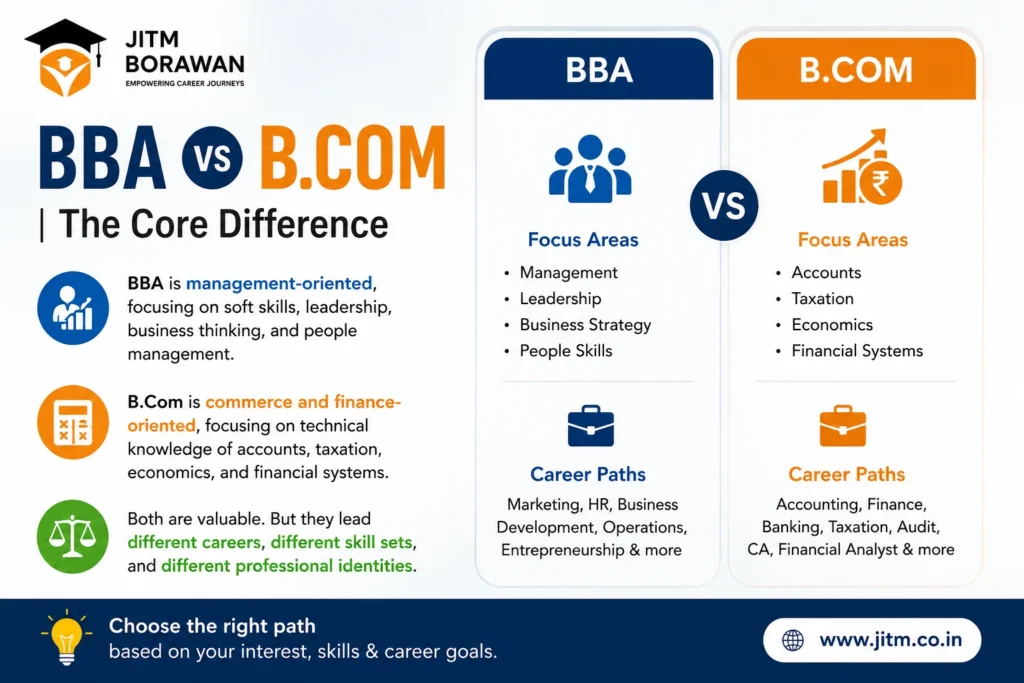
BBA focuses on developing soft skills, leadership, business thinking, and people management. B.Com focuses on technical knowledge of accounts, taxation, economics, and financial systems.
Both are valuable. But they lead to different careers, different skill sets, and different professional identities.
BBA vs B.Com | Course Comparison Table
| Parameter | BBA | B.Com |
| Full Form | Bachelor of Business Administration | Bachelor of Commerce |
| Duration | 3 Years | 3 Years |
| Focus Area | Management, Leadership, Business | Accounting, Finance, Commerce |
| Eligibility | 10+2 (any stream, usually commerce/arts) | 10+2 (commerce preferred) |
| Average Fees | Rs. 30,000 – Rs. 1,50,000 per year | Rs. 10,000 – Rs. 80,000 per year |
| Teaching Style | Practical, Case-Study Based | Theory-Based, Academic |
| Best For | Managers, Entrepreneurs, Marketers | Accountants, Finance Professionals, CA aspirants |
| Top Career Options | Manager, HR Executive, Marketing Head | Accountant, Tax Consultant, Finance Analyst |
| Higher Studies | MBA | M.Com, MBA, CA, CMA |
| Average Starting Salary | Rs. 3 – 6 LPA | Rs. 2.5 – 5 LPA |
BBA Syllabus | What Do You Study?
The BBA syllabus is designed to give students a 360-degree view of business management. Here is a semester-wise overview of what you typically study in a BBA program:
Year 1 (Foundation)
- Principles of Management
- Business Communication
- Financial Accounting
- Business Mathematics and Statistics
- Micro and Macro Economics
- Computer Applications in Business
- Organizational Behavior
Year 2 (Core Management)
- Marketing Management
- Human Resource Management
- Financial Management
- Business Law and Corporate Governance
- Operations Management
- Research Methods in Business
- Entrepreneurship Development
Year 3 (Specialization and Application)
- Strategic Management
- International Business
- Project Management
- Digital Marketing and E-Commerce
- Business Ethics and Corporate Social Responsibility
- Industry Internship and Live Projects
- Elective Subjects (based on specialization)
The BBA course places a strong emphasis on presentations, group projects, case studies, and industry exposure. Students are regularly evaluated on communication, leadership, and problem-solving abilities, not just exam scores.
B.Com Syllabus | What Do You Study?
The B.Com syllabus is more structured around accounting, economics, and commerce theory. Here is a general overview:
Year 1 (Foundation)
- Financial Accounting
- Business Economics
- Business Mathematics and Statistics
- Business Laws
- Computer Applications
- Environmental Studies
Year 2 (Core Commerce)
- Corporate Accounting
- Cost Accounting
- Income Tax Law and Practice
- Business Management
- Company Law
- Banking and Insurance
Year 3 (Advanced Commerce)
- Advanced Accounting
- Auditing and Corporate Governance
- Financial Markets and Services
- Indirect Taxation (GST)
- Management Accounting
- Project Work
B.Com students are expected to develop a deep understanding of financial systems, taxation laws, and accounting standards. The course is highly structured and prepares students for professional finance and accounting careers.
Also Read : Best BBA College in Khargone | Top 3 Options + Latest Fee Structure 2026
BBA vs B.Com | Career Options After Graduation
This is where the real difference becomes clear. BBA and B.Com lead to very different career paths.
Careers After BBA
BBA graduates are highly sought after in the corporate sector for management and business roles.
- Marketing Executive or Marketing Manager
- Human Resources Executive or HR Manager
- Sales Manager or Business Development Executive
- Operations Manager
- Retail Manager or Store Manager
- Digital Marketing Executive
- Entrepreneur or Start-up Founder
- Event Manager
- Management Trainee in MNCs and large companies
BBA graduates can also pursue MBA after graduation, which opens even higher-level managerial and leadership positions. With an MBA from a good college, the career growth is very fast.
Careers After B.Com
B.Com graduates are well-suited for finance, accounting, and commerce-based roles.
- Accountant or Senior Accountant
- Tax Consultant or Tax Analyst
- Financial Analyst
- Audit Assistant or Internal Auditor
- Banking Officer or Bank PO
- Insurance Agent or Financial Advisor
- Stock Market Analyst
- Government Jobs (SSC, UPSC, banking exams)
B.Com graduates can also pursue higher studies like M.Com, MBA (Finance), CA, CMA, or CS, which significantly boost their earning potential and career options.
BBA vs B.Com | Salary Comparison in India (2026)
One of the most common questions students ask is which course pays better? The honest answer is: it depends on what you do after graduation and which specialization you choose. But here is a realistic comparison based on current market trends:
| Career Path | BBA Graduate | B.Com Graduate |
| Fresher (Entry Level) | Rs. 2.5 – 4 LPA | Rs. 2 – 3.5 LPA |
| After 3-5 Years Experience | Rs. 5 – 10 LPA | Rs. 4 – 8 LPA |
| After MBA (BBA + MBA) | Rs. 8 – 20 LPA | Rs. 6 – 15 LPA |
| After CA (B.Com + CA) | Rs. 7 – 25 LPA | Rs. 7 – 25 LPA |
| Entrepreneur (BBA Route) | Unlimited | Limited |
Both courses can lead to very strong salaries but BBA + MBA combination is considered one of the best career tracks for corporate growth, while B.Com + CA is the gold standard for accounting and finance careers.
Which Course is Better | BBA or B.Com?
There is no single right answer. The better course depends entirely on who you are and what you want to become. But here are some clear guidelines:
Choose BBA if:
- You enjoy leadership, teamwork, and communication
- You want to run a business or work as a manager
- You are interested in marketing, HR, or entrepreneurship
- You plan to do MBA after graduation
- You prefer a practical, activity-based learning environment
- You want exposure to industries and corporate culture early
Choose B.Com if:
- You are strong in numbers and accounting
- You plan to pursue CA, CMA, or CS
- You want a career in banking, taxation, or finance
- You prefer academic and theory-based learning
- You want to prepare for government jobs after graduation
- You want a more affordable degree with lower fees
BBA vs B.Com | Which is More in Demand in 2026?
Both courses are in demand, but the demand is shifting. Here is what the job market looks like in 2026:
The corporate world is increasingly looking for management graduates with communication skills, business awareness, and practical experience. BBA graduates, especially those who have done internships and have strong communication skills, are finding it easier to get placed in entry-level management roles.
On the other hand, B.Com graduates who have pursued additional qualifications like CA, CMA, or an MBA in Finance remain extremely valuable. The finance and accounting sector never slows down. Every company in every industry needs finance professionals.
The real opportunity in 2026 is for students who do not stop at just a graduation degree. Whether you choose BBA or B.Com, the students who pursue higher education or professional certifications end up earning far more and growing far faster than those who stop at a bachelor’s level.
Can BBA Students Pursue MBA? Can B.Com Students Pursue MBA?
Yes, absolutely. Both BBA and B.Com graduates are eligible to pursue MBA after graduation.
BBA graduates have a natural advantage when it comes to MBA because the curriculum of BBA already aligns closely with MBA subjects. The transition is smoother, and many concepts are already familiar.
B.Com graduates who pursue MBA in Finance are some of the most powerful profiles in the job market because they combine deep financial knowledge with management training.
If you plan to do an MBA, JITM Borawan offers excellent MBA programs with industry-aligned curriculum, experienced faculty, and strong placement support across the Nimar and Malwa regions of Madhya Pradesh.
About JITM | Jawaharlal Institute of Technology and Management, Borawan
If you are a student from Khargone, Khandwa, Barwani, Burhanpur, or anywhere in the Nimar region of Madhya Pradesh, JITM Borawan is one of the most accessible, affordable, and career-focused management colleges near you.

JITM offers BBA and MBA programs with a curriculum designed to develop real-world business skills. Here is what makes JITM different from other colleges in the region:
What JITM Offers
- Three-year BBA program with industry-integrated curriculum
- Two-year MBA program with multiple specializations
- Experienced and dedicated faculty with industry exposure
- Regular workshops, seminars, and guest lectures from professionals
- Strong placement support with connections to regional and national companies
- A safe and disciplined campus environment with hostel facilities
- Affordable fees compared to colleges in Indore and other big cities
- Scholarship opportunities for deserving students
Campus and Infrastructure
JITM is spread across a 45-acre green campus in Borawan, Khargone. The campus includes modern classrooms, a well-stocked library, computer labs, sports facilities, hostel for boys and girls, and a temple. The environment is peaceful, focused, and designed to help students grow both academically and personally.
Placement at JITM
JITM has built strong relationships with companies across sectors including FMCG, banking, retail, insurance, and IT-enabled services. Students from JITM have been placed with companies across Madhya Pradesh and other parts of India. The college’s placement cell actively works to prepare students through mock interviews, resume workshops, and corporate interactions.
Why Students Choose JITM
Students from Khargone, Khandwa, Barwani, Burhanpur, Dhar, and Harda choose JITM because it gives them quality management education close to home, without having to spend the high costs of studying in Indore or Pune. The college focuses on holistic development not just degrees.
Contact JITM
- Phone: 07999231575
- Email: jitm.borawan@gmail.com
- Address: Piplai, Borawan, Dist. Khargone, Madhya Pradesh, India
- Website: jitm.co.in
Admissions for BBA and MBA 2026 are open. Limited seats are available. Contact the admissions team today for fee details, scholarship information, and campus visit scheduling.
Common Myths About BBA and B.Com
There are a few myths that confuse students when choosing between these two courses. Let us clear them up.
Myth 1: B.Com is only for students who want to become CAs. Reality: B.Com is a broad commerce degree. Many B.Com graduates go into banking, insurance, financial analysis, government jobs, and even MBA without pursuing CA at all.
Myth 2: BBA is easier than B.Com. Reality: BBA may have less heavy theory compared to B.Com, but it requires strong communication, presentation, and analytical skills. It is a different kind of challenge, not an easier one.
Myth 3: You cannot do an MBA after B.Com. Reality: B.Com graduates are fully eligible for MBA admissions through CMAT, MAT, and other entrance exams. In fact, many top MBA graduates are B.Com students.
Myth 4: BBA is only for rich students because fees are higher. Reality: While BBA fees can be slightly higher than B.Com at private colleges, many institutions like JITM offer BBA at very affordable fees with scholarship options.
Also Read : Best Job Oriented Courses After 12th for Boys & Girls in Khandwa & Khargone (2026 Guide)
BBA vs B.Com | A Quick Decision Guide
Still not sure? Use this simple guide to make your decision:
If you answered yes to most of these, go for BBA:
- I like talking, presenting, and leading people
- I want to start a business someday
- I am interested in marketing, HR, or management
- I plan to do MBA after my graduation
- I prefer learning through projects and real world activities
If you answered yes to most of these, go for B.Com:
- I am good at numbers and accounts
- I want to become a CA, CMA, or CS
- I prefer studying finance, taxation, and economics
- I want to appear for banking or government exams
- I want a lower cost degree with strong academic depth
Final Thoughts
BBA and B.Com are both excellent undergraduate programs. They are not competing against each other; they are simply built for different types of students and different career goals.
If you have the personality and ambition to lead, manage, market, and grow businesses, BBA is your path. If you have the analytical mind and the desire to master finance, accounts, and taxation, B.Com will serve you well.
What matters most is not which course you pick but how committed you are to making the most of it. Internships, certifications, communication skills, and higher education all play a massive role in how far you go after graduation.
Whether you choose BBA or B.Com, JITM Borawan is here to support your journey with quality education, strong faculty, and a campus environment that brings out the best in every student.
For admission enquiries, visit jitm.co.in or call 07999231575 today.
FAQs
Which is better, BBA or B.Com?
BBA is better if you want a career in management, marketing, or entrepreneurship. B.Com is better if you want to become a CA, work in accounting, or pursue banking and government jobs. Both are good. The right choice depends on your career goal.
Which has more salary, BBA or B.Com?
BBA freshers earn around Rs. 2.5 to 4 LPA and B.Com freshers earn Rs. 2 to 3.5 LPA. After higher studies, BBA plus MBA can reach Rs. 8 to 20 LPA and B.Com plus CA can reach Rs. 7 to 25 LPA. Salary depends mostly on your higher qualification.
Can a science or arts student do BBA?
Yes. BBA is open to students from any stream of science, arts, or commerce. You only need to have passed Class 12 from a recognized board. B.Com, however, is primarily designed for commerce students.
Can B.Com students do MBA?
Yes, B.Com graduates are fully eligible for MBA. They can appear for CMAT, MAT, or CAT entrance exams. B.Com plus MBA in Finance is one of the most in-demand profiles in the corporate job market.
Is BBA harder than B.Com?
Neither is harder, they are just different. B.Com needs strong numerical and accounting skills. BBA needs strong communication and leadership skills. Choose based on your strength, not difficulty.
Which course has better scope in 2026, BBA or B.Com?
Both have strong scope. BBA with MBA is seeing fast corporate demand. B.Com with CA or GST specialization is also highly valued. The key is not stopping at graduation; higher education makes both courses very rewarding.