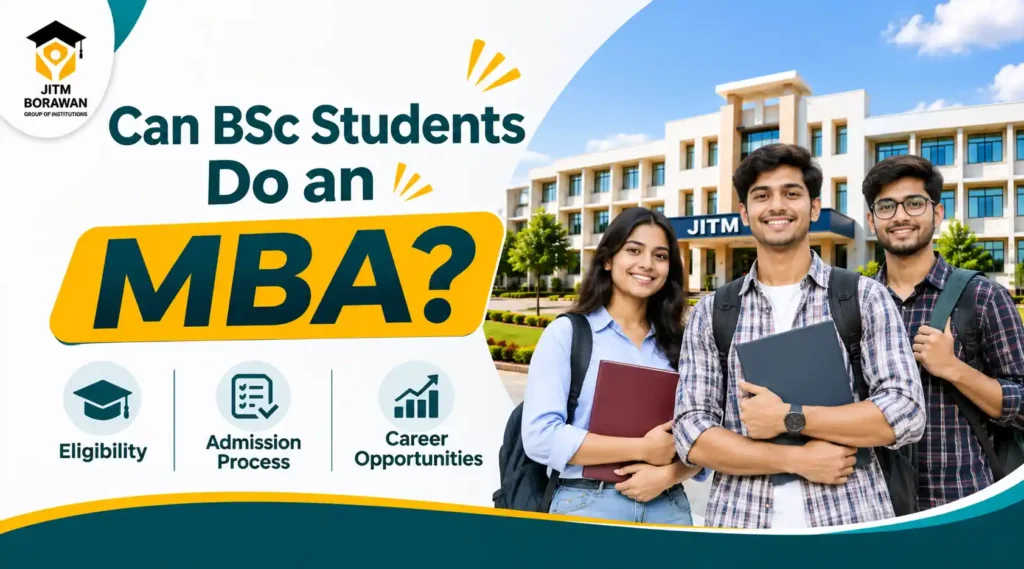
Yes, BSc students can do an MBA. You only need a bachelor’s degree of at least three years, and your stream does not matter. Most colleges ask for around 50% marks in graduation, and many accept CAT, CMAT or MAT scores. At Jawaharlal Institute of Technology & Management (JITM), Borawan, BSc graduates can apply for the MBA programme with the same eligibility as any other graduate. Science students often do well in management because they are strong in logic, numbers and problem-solving. These skills help in analytics, finance, marketing and operations. This guide covers eligibility, entrance exams, admission steps, specializations and career options.
Can BSc Students Do an MBA After Graduation?
Short answer: yes. Management education is open to graduates from every stream, so you don’t need a BBA or BCom background.
Is an MBA Open to Science Graduates?
Yes. An MBA is a postgraduate management course, and science graduates are welcome. Many students move from science to management once they realise that lab work or research is not what they want long-term.
Your science background can even work in your favour:
- You are used to working with data and numbers.
- You can break a big problem into smaller steps.
- You are comfortable with technical subjects like statistics and computers.
Which BSc Degrees Are Eligible for an MBA?
Almost all of them. Colleges usually accept:
- BSc (Physics, Chemistry, Maths)
- BSc (Biology, Biotechnology, Microbiology)
- BSc (Computer Science or IT)
- BSc (Agriculture, Home Science, Electronics and others)
The one condition is that your degree should be from a recognised university and should be a minimum of three years.
Is Work Experience Required for MBA Admission?
No. Most MBA programmes in India accept fresh graduates. Work experience is a bonus at some top B-schools, but it is not a rule for regular MBA admission. If you have done an internship or a part-time job, mention it in your application. It shows you understand how real work happens.
MBA Eligibility After BSc in India
Let’s clear up the confusion about marks and rules.
Minimum Qualification and Graduation Marks
The general rule across India is simple:
- A bachelor’s degree of at least 3 years
- Around 50% aggregate marks (usually 45% for reserved categories)
Some colleges ask for slightly more and some accept less. That’s why you should always check the college’s own notice before applying.
Can Final-Year BSc Students Apply for an MBA?
Yes, in many colleges. You can apply while your final-year exams are pending, and admission stays provisional until you submit your final result. JITM follows this approach too. Final-year students can apply provisionally. Just make sure you pass and clear the marks criteria before the cut-off date.
Are There Different Eligibility Rules for Different Colleges?
Yes. Government regulators like AICTE and UGC set the broad framework for management and higher education. But each college or university can add its own conditions, such as entrance exam scores, group discussion or interview.
Here is how it usually looks:
- Top B-schools (IIMs and similar): CAT score is a must.
- State and private universities: CMAT, MAT or state-level exam scores are common.
- Private institutes: Some give preference to exam scores but also run their own selection process.
Also Read : MBA After B.Com | Eligibility, Admission, Specialisations and Career Options
MBA Admission Process After BSc
The process is easy if you take it one step at a time.
Step 1: Check Your Eligibility
Confirm your degree length and your marks percentage. Then read the college’s eligibility page. For JITM, you can see the details on the eligibility criteria page.
Step 2: Choose an MBA Specialization
You don’t have to decide everything on day one, but have a rough idea. Ask yourself: do I like numbers, people, selling, or technology? (More on this in the specialization section below.)
Step 3: Check Entrance Exam Requirements
Find out which exam scores your target colleges accept. If you have not given any exam yet, check the next exam dates now. Don’t wait until admissions are almost closed.
Step 4: Submit the Application and Documents
Keep these ready:
- 10th and 12th marksheets
- BSc marksheets (or latest semester results)
- Entrance exam scorecard, if available
- ID proof and passport-size photos
- Category certificate, if applicable
Step 5: Complete the Selection and Admission Process
After applying, you may get a counselling call, interview or admission offer. Pay the fee on time to confirm your seat. If you want a step-by-step walkthrough at JITM, read our MBA admission guide or the admission process page.
Which Entrance Exams Are Required for an MBA After BSc?
CAT, CMAT, MAT and Other Entrance Exams
Here is what each exam is mainly used for:
- CAT: Needed for IIMs and many top-ranked B-schools.
- CMAT: Conducted by the National Testing Agency (NTA) and accepted by a large number of AICTE-approved colleges.
- MAT: A widely accepted test for private B-schools and universities.
- State-level exams: Many states run their own MBA entrance tests or counselling.
Can You Apply Without an Entrance Exam?
In some colleges, yes. Some institutes run their own entrance test or give admission based on graduation marks and a personal interview. But an exam score usually gives you better choices and, in many cases, better scholarship chances.
At JITM, candidates with valid CMAT, CAT, MAT or state-level entrance scores get preference. The college also runs its own JITM Entrance Exam, and high scorers can get a merit-based scholarship. If you don’t have a score, speak with the admission team and ask about your options.
How to Check the Admission Route for Your Chosen College
Don’t depend on random websites or social media posts. Do this instead:
- Open the college’s official website.
- Read the MBA eligibility and admission pages.
- Call or visit the admission office to confirm.
- Ask for the latest notice with dates and fees.
Also Read :
Low Fee MBA College with Hostel in Khargone MP
Best MBA Specializations for BSc Graduates
There is no single best specialization. The right one depends on your strengths and interests.
MBA in Business Analytics
Good for students who enjoyed maths, statistics or computer science. You will work with data, reports and tools to help companies make better decisions. If you want to know more, read our guide on MBA in Business Analytics in Khargone.
MBA in Finance
A strong choice if you like numbers, budgeting and markets. You can work in banking, investment, accounting and corporate finance.
MBA in Marketing
Best for students who are good with communication, creativity and understanding what customers want. Roles include brand, sales, digital marketing and market research.
MBA in Human Resource Management
For those who like working with people. HR handles hiring, training, employee relations and company culture.
MBA in Operations Management
If you enjoy planning, process improvement and making things run smoothly, this is for you. It connects well with supply chain, logistics and production.
Also Read :
MBA Finance vs MBA Marketing
Career Opportunities After an MBA for BSc Graduates
An MBA opens doors across industries. Your first role will depend on your specialization, skills and internship experience.
Business Analyst and Data-Oriented Roles
Companies need people who can read data and explain it in simple words. Common roles are business analyst, data analyst and MIS executive.
Marketing and Sales Management
Typical jobs include marketing executive, brand associate, digital marketing executive and sales manager.
Finance and Banking Careers
You can start as a credit analyst, financial analyst, relationship manager or banking officer.
Human Resources and Operations
Options include HR executive, talent acquisition specialist, operations executive and supply chain coordinator.
Skills That Can Improve Your Career Prospects
Your degree gets you the interview. Skills get you the job. Work on these:
- Clear English communication, spoken and written
- Excel and basic data skills
- Presentation and teamwork
- Time management and a learning attitude
- Hands-on experience through internships and live projects
About salary: it varies by city, company, specialization and your skills. A fresher’s pay will be different from someone with 3 to 5 years of experience. For realistic job roles and market information, you can browse the government’s National Career Service portal. Be careful with any website that promises a fixed salary after MBA.
MBA After BSc at JITM Borawan
If you are looking for an MBA college in Khargone district, JITM is worth shortlisting. The campus is in Piplai, Borawan, and is spread across 45 acres.
MBA Eligibility at JITM Borawan
According to the official JITM MBA page:
- You need a minimum 3-year bachelor’s degree with 50% aggregate marks (45% for reserved categories).
- Final-year appearing students can apply provisionally.
- Preference is given to valid CMAT, CAT, MAT or state-level entrance scores.
- Merit-based scholarships are available for high scorers in the JITM Entrance Exam.
- Children of serving or retired Army and Defence personnel can get fee relaxation (proof required).
MBA Curriculum and Practical Learning at JITM
The course starts with the basics of management and builds up slowly, which is helpful if you come from a science background.
- Semester 1: Principles of Management, Quantitative Techniques, Accounting for Managers, Business Communication and more.
- Semester 2: Operations Management, Financial Management, Marketing Management, HRM and Business Research Methods.
- Semester 3 and 4: Supply Chain, Project Management, Business Legislation and Strategic Management. You can pick electives in Marketing, Finance, HR or IT.
- Practical side: Students do an MRP, internship or field work, followed by a comprehensive viva.
Students also get 3 industrial visits every year (1 to 3 days each), along with expert lectures and industry talks. You can see more on our placements page.
How to Explore MBA Admission at JITM
- Read the MBA programme page and the fee and payment schedule.
- Fill out the registration form.
- Talk to the admission team and confirm the latest dates and requirements.
Still comparing colleges? Our checklist, 10 things to check before choosing an MBA college, will help you decide.
MBA After BSc vs MSc: Which Is Better for Your Goals?
Neither is better for everyone. They lead to different paths.
When an MBA May Be a Better Fit
- You want a career in management, business, sales, finance or HR.
- You enjoy leadership, teamwork and decision-making.
- You are okay moving away from pure science.
When an MSc May Be a Better Fit
- You want a career in research, teaching or a lab-based role.
- You plan to do a PhD or prepare for NET or other academic exams.
- You love your subject and want to go deeper.
How to Choose Based on Your Career Goals
Ask yourself three questions:
- What kind of work do I want to do every day?
- Do I enjoy my science subject enough to study it for two more years?
- Where do I see myself in five years?
Talk to seniors, teachers or people already working in both fields. Their honest experience helps more than any article.
Frequently Asked Questions
Can I do an MBA after BSc without work experience?
Yes. Most MBA colleges in India accept fresh graduates. Work experience is not required for regular MBA admission.
Can BSc students apply for an MBA in Business Analytics?
Yes, in most colleges. Students with maths, statistics or computer science backgrounds usually find it easier, but it’s open to other BSc students too, provided the college’s eligibility is met.
What is the minimum percentage required for an MBA after BSc?
Most colleges ask for around 50% in graduation (45% for reserved categories). At JITM, it is 50% aggregate (45% for reserved categories). Always check the latest notice of the college you are applying to.
Can I pursue an MBA without CAT or CMAT?
Some colleges allow it, through their own entrance test or a merit-and-interview process. However, a valid score gives you more options. At JITM, valid CAT, CMAT, MAT or state-level scores get preference, so contact the admission team to confirm your case.
Which MBA specialization is suitable for BSc graduates?
It depends on your interest. Maths and computer science students often like analytics or finance. Good communicators may enjoy marketing or HR. If you like planning and processes, try operations.
Can final-year BSc students apply for an MBA?
Yes, many colleges allow it. Your admission stays provisional until you submit your final result, so make sure you meet the marks requirement.
Conclusion: Is an MBA After BSc the Right Choice?
An MBA after BSc is a smart move if you want to work in business, finance, marketing, HR or analytics. You need a 3-year bachelor’s degree, around 50% marks, and in many cases an entrance exam score. Choose your specialization based on what you enjoy, not what’s trending. Then compare colleges carefully. If you are exploring options near Khargone, visit the JITM MBA page to check the curriculum, eligibility and admission details, and take the first step toward your management career.
.